In August of 2023, the city of Corvallis kicked off a project to study the Monroe Avenue Corridor between 14th and 26th street, and how we can improve it for all users. Over multiple community meetings and design options, the city has settled on its final design. A protected two-way cycle track on the south side of Monroe, with a host of other safety and traffic calming features across this stretch, such as raised intersections. Now, this preferred plan will be presented in front of the Corvallis City Council so the city can adopt the recommendations into the Corvallis Transportation System Plan.
This project is a step up from the current existing conditions. There are major safety and visibility upgrades for pedestrians and cyclists. The protected cycle track makes it safer for cyclists to bike through the area. The sidewalks are being widened, and crosswalks, both at intersections and mid-block, are going to be visibly marked and raised to highlight the sections where pedestrians are likely going to be crossing.
However, this project is likely not going to happen anytime soon. Funding remains a big issue, and talking with project consultant Phil Worth, he hopes the city will pursue grant opportunities available for projects of this nature.
And this is the biggest issue with this project. At all the open house meetings, community members, stakeholders, and businesses along Monroe seemed pretty excited about this project and the improvements it’ll make along the corridor. But looking at the preferred plan, with all the safety upgrades, all the raised intersections, green paint, and sidewalk widening, all I see is dollar bills. The project consultants failed to give an estimated price tag, but I can assure you, it is going to be expensive. It would take years to secure funding and years to actually construct the added infrastructure. I would not be surprised if this project gets completed after 2040. Which begs the question, what even is the point of having all these discussions? Our city has more pressing priorities right now. Many of its traffic signals are nearing their 50-year lifespan after being built in the 1970s during the city’s rapid growth due to HP. There’s a funding crunch to replace our aging traffic lights, which can cost upwards of a million dollars per intersection for all 35-ish signalized intersections. The city has to allocate money to maintain its existing road infrastructure. There’s also a push to speed up the neighborhood bikeway program, and the city has received road safety audits that recommend safety upgrades for our major arterials.
So, where does this leave Monroe Avenue?
Should we put time and money into trying to make safety improvements to Monroe Avenue? Absolutely. The only problem: the current plan is too complicated and expensive.
Instead, the best way to achieve all the project goals: enhance pedestrian, bicycle, and transit use along the corridor, Better integrate the edge of campus with the City, and help the City & OSU plan for future development along Monroe Avenue, is to just ban cars on Monroe Avenue.
Monroe Avenue is the most unique street in Corvallis. I would argue that outside of the downtown business core, it sees the highest amount of pedestrian traffic. Drive down Monroe Ave when Oregon State is in session, and you’ll see the immense number of college students walking on both sidewalks and trying to cross the street.
In fact, it almost seems like pedestrians outnumber vehicles traveling on Monroe Ave! Local businesses also receive a huge percentage, higher than anywhere else in Corvallis, of customers from students walking and not travelling by car.
The amount of pedestrian traffic on the corridor should already make it a perfect choice for a car-free street. If that many people walk and bike down this corridor, shouldn’t the street design reflect and cater to the majority of users? Nowhere else in Corvallis does a street have this many pedestrians using the street. If this ratio of pedestrian volume to car volume existed in Europe, this street would be one of their amazing cobblestone, plaza streets.
But here in America, we have a bias towards cars. Decades of car-centric development and design choices have conditioned us to believe that everything we build has to be for cars, and that roads should be prioritized for cars. That’s how we end up with these giant multi-lane roads and huge swaths of parking lots in shopping malls. So in America, if we were to propose changing the function of a street from a tool to move cars from one place to another, to one that’s used for community gatherings and public spaces designed at a human scale, it needs more than high pedestrian traffic.
And that’s where Monroe Avenue does a surprisingly good job at.
First, its location. Since the street borders the north side of the OSU campus, there’s not a significant amount of vehicles heading to and from the south side of Monroe. That means that we don’t have to worry about cars crossing the street, North-South interrupting the pedestrianized sections. The street being on the “edge” means that vehicles won’t have to make significant detours around the pedestrianized street in order to go from North to South.
Closing Monroe to cars and giving it back to people will have the biggest impact on east-west traffic. Obviously, cars that use Monroe to go east-west can’t use the street anymore. However, just 2 blocks north of Monroe, there is a major arterial, Harrison and Van Buren, that drivers can use to go east-west of the city. If you think about it, no driver really should be driving on Monroe Avenue unless they are accessing a business on the street. Closing it to cars won’t have a huge impact on routes, as drivers just have to make a 2-block detour for their commute. Not many roads can say that there is another road that goes in the same direction, nearby to absorb vehicle traffic.
Vehicles can use the perpendicular side streets to access most businesses as many of the parking lots connect to these side streets. The parking situation is going to be tricky, but the current proposed plan also takes away many of the pre-existing on-street parking spaces. Unfortunately, it isn’t as simple as having people park on the residential side streets. The streets north of Monroe, as one community member pointed out, are one of the densest residential areas with the highest demand for parking. And yes, I’ll admit, that these are the two biggest drawbacks to the proposals outlined. But then there’s also the debate on whether a street, maintained by taxpayer dollars, should be used as a place to store someone’s car…
Second, the street character. Monroe is already a street surrounded by businesses, many of which are local. This means that if Monroe Ave becomes a pedestrianized plaza, the corridor can become a destination for the community to hang out. They can walk down the corridor to shop, eat, and visit the local businesses. This will undoubtedly attract a greater number of customers, drawn by the aesthetics of the street once it is pedestrianized into a plaza. Businesses can use this opportunity to put outside seating areas on the street. Furthermore, the current design of Monroe supports a pedestrianized street. Many of the buildings are close to the street. They have a low horizontal setback and aren’t separated by massive parking lots, making the business feel connected and part of the streetscape rather than being attached to a parking lot that is attached to the road. Its density makes it convenient to access to those who are walking and biking and creates a sense of place for people.
Furthermore, despite being a commercial street lined with businesses, it doesn’t get a lot of vehicles. It isn’t a heavily trafficked corridor like 9th Street, and the surrounding streets can easily absorb the displaced traffic.
Finally, there is already a desire by the community and city to improve the street. This is actually the biggest barrier to any street improvements. The will to do something about it. And if the city is already going to put time and money into improving this street, why settle for less? If we truly believed in achieving the 3 goals of the project, a car-free version of Monroe easily beats out the current plan. The best way to enhance the aesthetics of the corridor and create a gateway to campus, the best way to increase safety and walkability, the best way to promote the upcoming development while supporting existing business? A Car-free street.
Yes, putting in those safety upgrades would work too. But cost is the biggest factor that makes or breaks any road project. It’ll take years for any of these improvements to become reality, all while it still isn’t safe for pedestrians walking and cyclists biking. And think about trying to use the street and access businesses during construction. It’ll be a painful nightmare for everyone.
But closing a street to cars is simple and inexpensive.
Why? Because it removes the thing that drives up the cost of the proposed design. Cars. The reason all the costly safety infrastructure improvements are being added to Monroe is just to accommodate cars on the street, so cars and bikes can coexist. We are spending the extra millions of dollars so cars can drive on the street. But cars aren’t needed on Monroe Avenue. If you look at the plan, no sane driver would willfully choose to drive on Monroe if it means stopping at a stop sign almost every block, and going over a speed bump or a raised intersection every hundred feet. We are spending at least 20 million dollars just so a couple thousand cars can drive on Monroe each day. That money that was being spent to keep cars on Monroe could be spent on other active transportation safety projects across the city on roads such as Walnut, Circle, Harrison, and 9th. It is unnecessary and unwise to spend money on these infrastructure improvements on a road that doesn’t need cars.
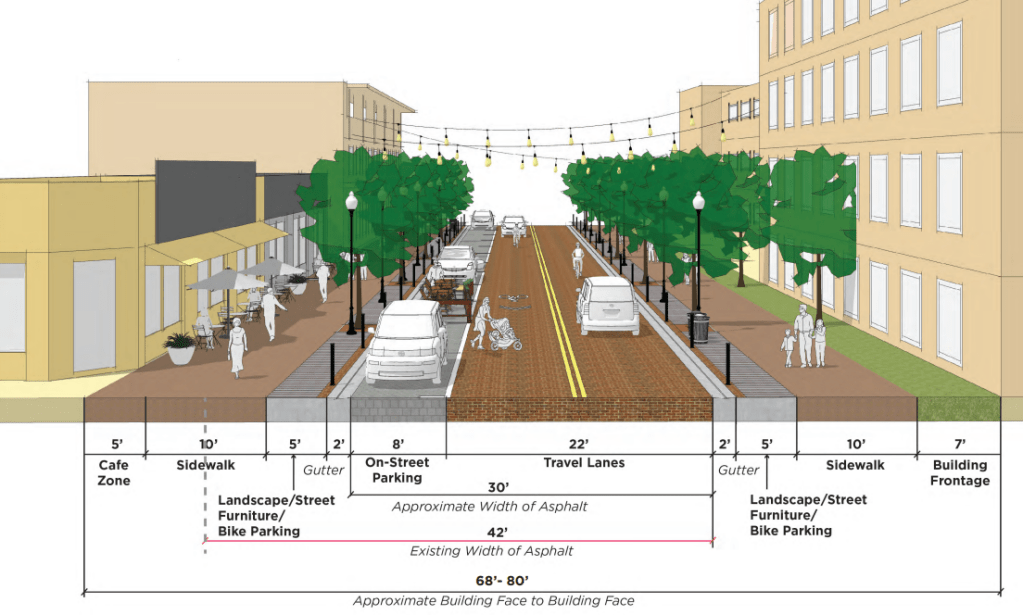
So what’s the vision for Monroe? The next time you walk on the north side of Monroe, imagine the sidewalk extending into the road about the length of the parking space + the bike lane. There would be more space for pedestrians and space for outdoor cafes. On the south side, the sidewalk would extend into the road for about the width of the bike lane. The two travel lanes would be a curbless festival street. Cars would be restricted from travelling down the, but the occasional bus and delivery vehicles would be able to drive down the curbless travel lane. There isn’t a need to dedicate extra space or money for a protected bike lane as vehicle traffic would be so low, freeing more space on the road for sidewalks and public community use. Trees, greenery, and landscaping can all be added to beautify the streetscape. It would look almost like one of the proposed designs the consulting team initially made except there would be no cars.
Imagine Monroe Avenue being the pride of the city. A destination where our community can gather. Where we can take back our street for community use instead for someone to park their metal box (car). It becomes a vibrant, livable place where we can gather and visit local businesses. It is a human centered space, designed for people and not for cars.
We ought to spend our money wisely on projects that will have the greatest impact on its residents. Yes it is big, ambitious, and unprecedented. But we have an opportunity like Monroe, the almost perfect street for a car-free one, and a plan to put money into improving the street. To best impact its residents while also costing the least, a car-free street is the no-brainer option.
If you’ve ever visited a walkable European car-free plaza, the vibe just hits different. Cities across America are trying to emulate this and catch up with their own mini-version of Main Street. Our urban places don’t have to be designed solely for cars. The City of Corvallis is committed to this. We’ve invested millions of dollars to promote walking and biking. We are committed to the vision zero strategy of zero traffic fatalities. We even hold, every year, an Open Streets Festival that closes a one-mile street to cars to reimagine our shared public spaces as car-free places where people want to walk, bike, and play. We have an opportunity to redesign a street and make it more than just a street. A different future is always possible. Whatever the city chooses to do with the Monroe Avenue corridor is ultimately a reflection of what and who it prioritizes.
Proposed Concept: https://archives.corvallisoregon.gov/public/ElectronicFile.aspx?dbid=0&docid=4702439
Festival Curbless Street Design:
https://archives.corvallisoregon.gov/public/ElectronicFile.aspx?dbid=0&docid=4413696