As enrollment declines and budgets continue to shrink, school closure is on the horizon. While the community is focused on possible elementary school closures, a decision impacting the high schools is more imminent than people may think. Crescent Valley High School in its current capacity as a functioning, accredited, and comprehensive secondary school, will likely cease to send students across the graduation stage within or near the end of the decade. The situation the district finds itself in has left this conclusion irrefutable. In this editorial, I will be highlighting the drastic circumstances leading to tens of millions of dollars in deficit and thousands of students less in the district as well as showcasing where the school board consented to this result.
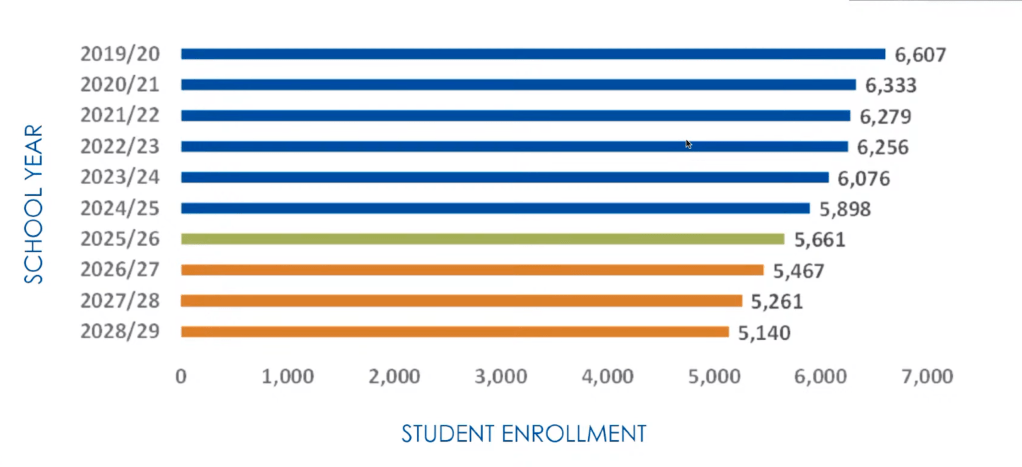
First, it is important to paint the picture of Corvallis School District’s dire financial and enrollment situation. Student enrollment was at 6,607 in fiscal year 2019-2020. The projection for the fiscal year 2028-2029 is 5,140 (2025). In less than ten years, our school district is decreasing a projected 1,467 students or 22.20%. This is the “lowest enrollment since 1959” according to CSD Financial Director Lauren Wolfe (A reminder: Corvallis was a one high school town in 1959).
This change has been attributed to lack of affordable housing and a birth rate decline. Yes, many aspects, including those, have an effect on our enrollment but if you actually look at City data, you will find Corvallis’ situation is not at all like its School District’s. First of all, Superintendent Ryan Noss often claims families are moving out of Corvallis and/or commuting to Corvallis for work due to the City’s high housing costs. City of Corvallis Data actually shows that Corvallis’ in-commuters (meaning those who come into Corvallis for work but do not live here) has decreased consistently since 2019 and we are now at the same level as 2010 with 17.9k in-commuters. In contrast, the amount of out-commuters (those living in Corvallis commuting out for work) has increased to 11k: the highest in our City’s history. Corvallis’ population has also increased a record 2.3 thousand from 2022 to 2023 with OSU student increase only accounting for 700 of that number (Population). It is important to note that Corvallis’ had 650 births in 2013 compared to a decade later with only 562 in 2023. So there clearly is a portion of the enrollment decline that can be attributed to birth rate declines.
Given these figures, the district’s enrollment decline does not align with the overall population trends of Corvallis. The district’s financial decisions, administrative choices, and allocation of resources have undoubtedly played a role in Crescent Valley’s projected demise. Rather than addressing systemic issues, the district has seemingly allowed a slow erosion of CVHS, reinforcing the perception that it is the lesser school, making it less attractive to prospective students and families. The repercussions of this will not just be felt by CVHS students, but by the entire district, as closing one of Corvallis’ two high schools will have lasting consequences on educational quality, community identity, and student opportunities.
Let’s look at the finances. If the Corvallis School District continues to operate at the current levels, the 2025-26 school year will be burdened with a 2.98 million dollar deficit, the 2026-27 school year with an 11.78 million dollar deficit, and the 2027-28 school year with an 18.01 million dollar deficit. Correcting the 2027-28 number would mean eliminating almost 15% of the district’s total operating expenditures. At the February 6th School Board meeting Lauren Wolfe stated, “Reducing $18.01 million is not possible without some serious and significant structural changes.” However, she stated, “In 27/28 we are not going to be talking about an 18.01 million dollar reduction.” Wolfe is implying that a decision is in the works to prevent the deficit. And in her words, it would have to be significant. Some district office administrators have been speaking openly about the possibility of “Corvallis being a one high school town” or “Crescent Valley being a CTE school”.

However, many wonder why Corvallis and Crescent Valley are so unevenly distributed in enrollment, leaving Crescent Valley as the natural first high school to close. For the 24/25 school year, CHS began with 1267 students to CVHS’s mere 798. Mind you, in 2010, CHS had 1,154 to CV’s 1,088: A mere 66 student difference to today’s 469. Additionally the total high school students in 2010 was 2,242 in comparison to the 2024 amount of 2,065. That is not the 22% difference seen district wide. So the question becomes, when was it decided to start pushing for an easy decision? Was there a time when inaction was allowed to permit Crescent Valley to be the default school to close? We were almost equal in population 15 years ago.
It all started in June of 2001. The District was facing a school survivor fight where schools and families were competing to protect their continuation. The Board decided to delay closing a school. The Gazette wrote, “Delay could help board members look from another angle: not which schools to close, but which are most natural to keep open, followed by redrawing attendance boundaries for all of those that remain.” (CItE) You’ll notice the term boundaries arise often. The boundaries determine which elementary, middle, and high school a student can attend. To balance enrollment between high schools, redrawing boundaries would be the most efficient and simple way to do it. Despite the parents’ distress at their children having to go to Crescent Valley, consolidation has worked before. In 2003, Corvallis’ two middle schools were consolidated and two elementary schools were closed. It was responded to with apprehension but later the Principals of these schools reported on positive consolidation and community among students. However, in April 2003, the Corvallis School District adopted an open-enrollment policy. The following year, 312 Crescent Valley High School boundary students transferred to Corvallis. Only 121 went from Corvallis to Crescent Valley ((Reporter, 2004) Then assistant to the superintendent Jeanne Holmes stated, “At committee meetings, parents, educators, administrators, and other district staff haven’t found any glaring discrepancies in the quality of education offered at Corvallis schools. What’s bringing this to a head is the funding issue because money follows students.” So it began, Corvallis received more transfers from Crescent Valley boundaries almost every single year after.
In May of 2005, less than three years after the Corvallis School District shut three schools in response to declining enrollment and closing a budget gap, officials planned to take another look at district programs and resources and considered adjusting attendance boundaries and closing another elementary school. The current superintendent was confident the closing school would be turned into a science academy. This echoes the sentiment that CV will become a CTE or Magnet school. Alas, Inavale, the K-8 school which the district hoped to convert to a science academy, closed completely (2005).
Again, the talks of closing a school came to the School Board in late 2005. Then school board member Helen Higgns cautioned that there is no “quick fix” to declining enrollment and uncertain future school funding from the state. The board said that any changes that would take effect next school year would be made by December (2005). No schools were closed and no boundaries were redrawn. Year after year they punted the hard task to the next school board while they themselves moved on to higher positions (Sara Gelser to the State Legislature, Helen Higgins to run for Benton County Commissioner)
While our district was declining as a whole, open enrollment continued to wreak havoc on CV. Crescent Valley High School had an enrollment of 1274 in September 2000. In September of 2005 the enrollment was at 1060, a difference over the five year period of 214 students, or a shift ranging from 16-20% in the resources available to run the school program (News-Gazette). That’s why in January 2006, Superintendent Dawn Tarzain proposed to the school board the ending of transfers from Crescent Valley to Corvallis High. She speculated the enrollment would be even in 3 years.
Redrawing the boundaries came up again in 2007. Enrollment wasn’t evening out and plans were drawn so that students who live in Oak Creek would be shifted from the CHS/Linus Pauling attendance area to the Cheldelin/CVHS area. Over 75 parents crowded the school board meeting to speak in opposition. Parents expressed the usual concerns about being split up or preferring CHS/LP (Nitson, 2007). But surprise! Just as the board seemed the most primed to approve the changes, the Superintendent withdrew. The boundaries remained the same. However, two months later the board adjusted some elementary boundaries which did not affect the numbers going to CHS or CV.
Now the town was quiet until 2015 when the district projected an increase in enrollment. Plans were drafted to rebuild elementary schools and upgrade buildings. The drafts were completed in August of 2019. Also that year, new superintendent Ryan Noss began the push to redraw the boundaries as he wanted to even out the schools. The district accurately assessed the lopsidedness of the enrollment with four elementaries feeding into one middle school and three elementaries feeding into the other. In addition, two of the elementaries feeding into the larger middle school are dual-immersion, magnifying the lopsidedness. At a meeting one week before the Covid-19 outbreak in March of 2020, Noss presented his plan to begin sending Jefferson students to Cheldelin and CVHS. It was responded with community outrage and disapproval from the boundary review committee. Noss added he had looked at a different set of numbers and drawn a different conclusion than that of the committee. “The best way to reduce overcrowding at Linus Pauling without splitting up friend groups or overly disrupting families,” he said, “is to shift all of the Jefferson catchment area to feed into Cheldelin and Crescent Valley.” Noss was right, and the school board’s failure to act condemned Crescent Valley to closure.
As Covid-19 raged, the district’s objective turned to making the best of education during the pandemic. The pandemic continued a trend of private, home school and charter. By 2024, private school enrollment had almost doubled since 2014 with an 80.61% increase, charter enrollment ballooned with a 119% increase, and home school continued upward with a 17% enrollment increase (2012). As we returned to school, enrollment was at an all time low and budget cuts took center stage. Crescent Valley’s future could not be saved.
For the students, teachers, and alumni of Crescent Valley, this reality is a painful one. It is a reminder that administrative neglect and systemic bias can shape the fate of a school just as much as demographic trends and financial constraints. The decision to effectively phase out Crescent Valley is not a reflection of its quality or the dedication of its community, but rather the culmination of years of policy decisions that have prioritized convenience over longevity.
The consequences of these decisions have come to a head. The Corvallis School District is in an undeniable financial crisis, and rather than explore a balanced approach to cost-saving measures, the district is signaling that Crescent Valley will bear the brunt of the fallout. Whether through closure, conversion into a specialized program, or a slow erosion of its resources, the writing is on the wall: Crescent Valley High School, as we know it, is on borrowed time. In response to an inquiry from the Crescent Crier, Ryan Noss affirmed that “closing, converting to a magnet or CTE school, or phasing out Crescent Valley High School” are possibilities. However Noss stated, “But we will not make a determination until we have more community engagement.”
The students of Crescent Valley deserve better than to be treated as an afterthought in the district’s financial balancing act. They deserve the same investment, attention, and respect that CHS students have received for years.